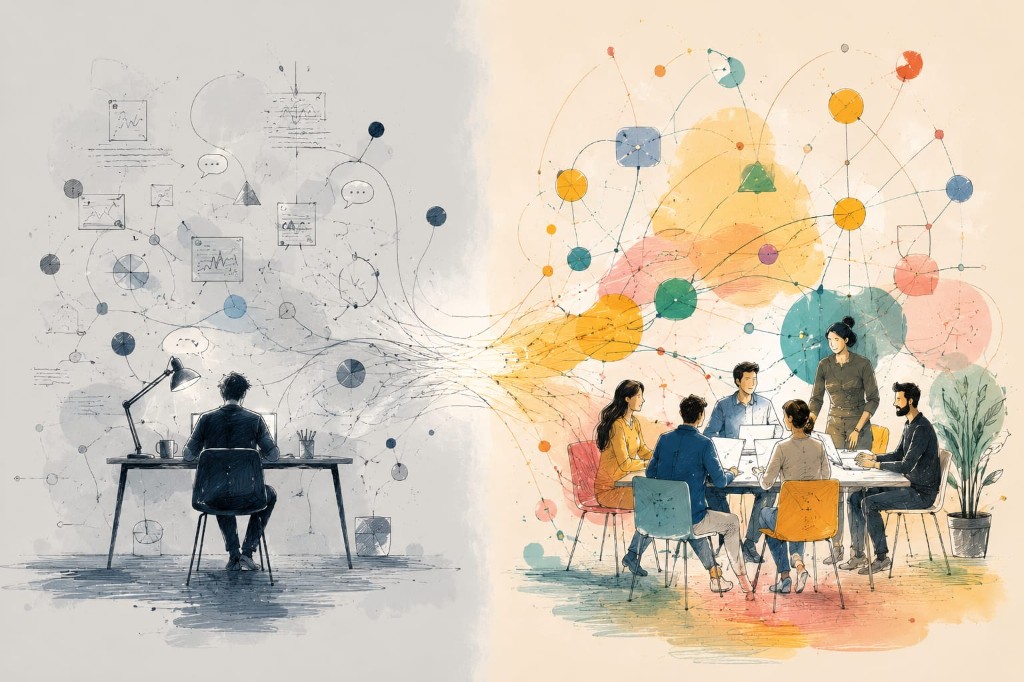
There’s a moment that happens when you first start using AI tools seriously—not casually, not experimentally, but as part of how you actually get work done.
At first, everything feels magical.
You type. It responds. You iterate. It improves.
You feel faster. Smarter. Slightly dangerous, even.
And then—after a few weeks—that magic starts to split into two very different directions.
That’s where tools like Manus AI and Numma Collab stop looking similar… and start revealing what they’re really built for.
Let’s not over-intellectualize it yet.
One helps you think better. The other helps teams think together without collapsing into chaos.
Simple. But not shallow.
Because everything else flows from this.
Manus AI feels like sitting with an incredibly capable thinking partner who never gets tired, never loses context (well… mostly), and doesn’t mind going back and forth with you 47 times until something feels right.
It’s intimate.
It’s direct.
It’s you vs the problem.
What it does exceptionally well:
It shines in moments like:
“I need to figure this out.” “I need to write this better.” “I need to think this through clearly.”
And Manus delivers—fast.
But here’s the subtle limitation:
Manus assumes something very important:
That the unit of work is the individual.
And in many cases, that’s true.
But in modern work? That assumption quietly breaks.
You can have five incredibly smart people, each using Manus AI.
Each one producing high-quality outputs.
Each one thinking clearly.
And still…
Because intelligence isn’t the bottleneck anymore.
Coordination is.
And this is exactly where Manus AI—by design—doesn’t try to solve the problem.
Numma Collab starts from a completely different premise:
What if the problem isn’t thinking better… but thinking together without friction?
Instead of optimizing the individual loop, it redefines the environment where thinking happens.
Not chats. Not documents. Not isolated prompts.
But a living, shared cognitive space.
With Manus AI, you focus on outputs:
With Numma Collab, the focus shifts to something more fundamental:
How ideas move, evolve, and connect across people.
It’s less about:
“What did you produce?”
And more about:
“How are we thinking together right now?”
Let’s make this real.
With Manus AI:
With Numma Collab:
With Manus AI:
With Numma Collab:
With Manus AI:
With Numma Collab:
This is something most comparisons ignore—but it’s critical.
Manus AI feels like:
It’s satisfying in a “craft” kind of way.
Numma Collab feels like:
It’s satisfying in a “we’re actually moving” kind of way.
Let’s be fair—there are spaces where Manus AI is simply the better tool.
If your work is primarily individual execution, Manus AI is not just enough—it’s excellent.
Numma Collab becomes undeniable when:
In other words:
When the cost of misalignment is higher than the cost of thinking.
Here’s the uncomfortable truth:
Most teams don’t struggle because people aren’t smart.
They struggle because:
Manus AI doesn’t fix that.
It makes individuals sharper inside the same broken system.
Numma Collab, on the other hand, quietly asks:
“What if the system itself is the problem?”
Choosing between Manus AI and Numma Collab isn’t really about features.
It’s about how you believe work should happen.
If you believe:
Great work comes from smart individuals doing their best thinking independently
→ Manus AI will feel natural.
If you believe:
Great work emerges from shared understanding, continuous context, and fluid collaboration
→ Numma Collab will feel like a relief.
You probably don’t choose one.
You outgrow one into the other.
You start with Manus AI
You become faster, sharper, more capable
Then you hit coordination limits
Then you realize: speed alone isn’t enough
And that’s when Numma Collab stops being “interesting”…
…and starts being necessary.
Manus AI helps you think.
Numma Collab helps thinking scale without breaking.
And in a world where complexity is rising faster than individual intelligence can keep up…
That difference becomes everything.